

A future society without ageism
What if age was no longer a limitation, but a source of strength? At the 2026 Future Festival in Reykjavík, participants envisioned a society free from ageism, where generations connect, technology empowers, and shared spaces bring people together.
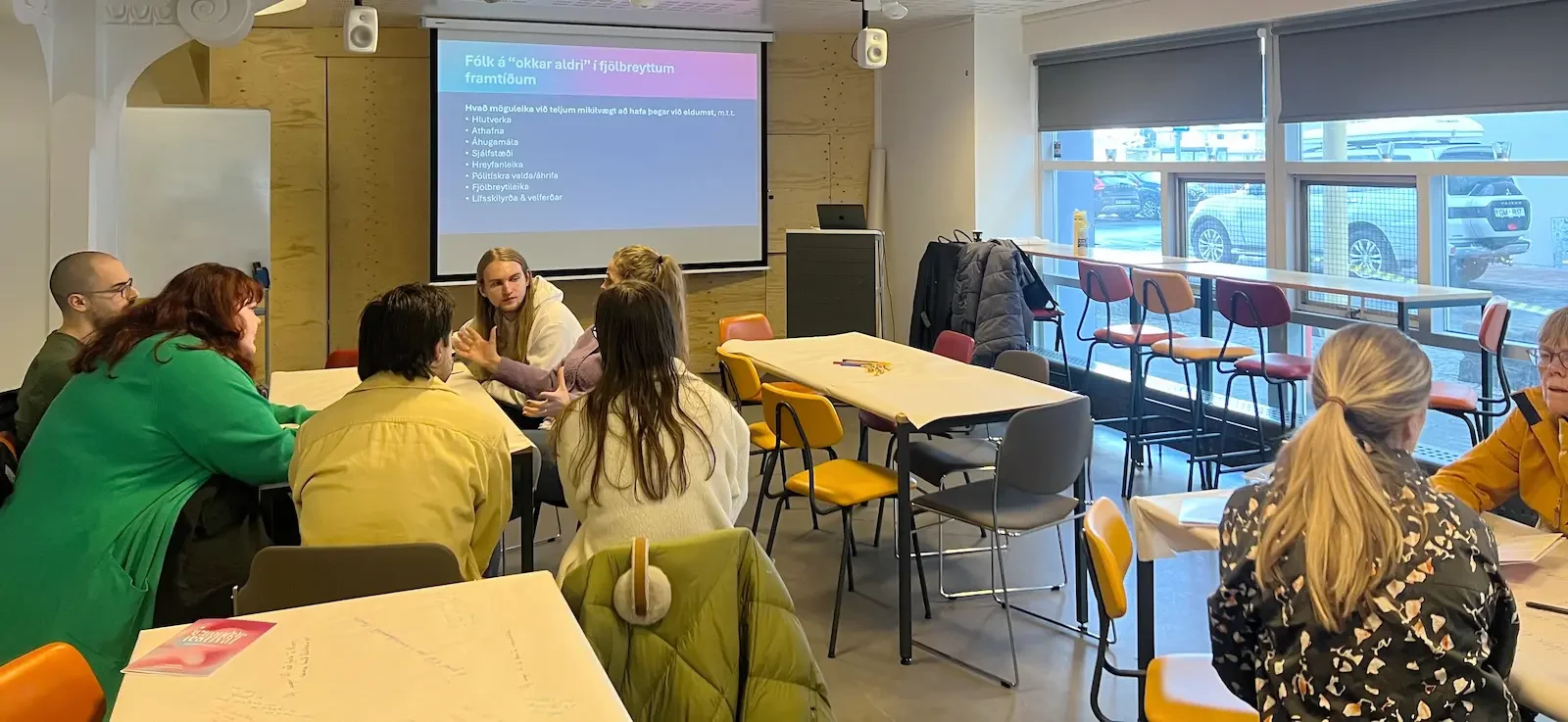
At the 2026 Future Festival at Reykjavik City Library, Grofin, two workshops were held under the title “A Future Society Without Ageism.”
The aim of the workshops was to bring together people of different ages to discuss the drivers of ageism, explore the role of technology, and strengthen futures literacy toward a society in which age is not a barrier but a strength. The event was a collaboration between the Icelandic Centre for Futures Studies and the knowledge platform Farsæl öldrun, and formed part of the Northern Futures Hub project.
Around 20 people took part, and the atmosphere was relaxed and welcoming while also being deep and meaningful.
The first workshop: General mapping of experiences and attitudes
In the first workshop, the conversations were broader and more open. Many everyday examples emerged of how ageism shows up in people’s lives. Participants described experiences of being seen as too young to understand, decide or take part, but also too old to change career, return to school or try new things.
This first part highlighted how ageism is often woven into the unspoken rules of society about what is considered appropriate at a certain age. It appears in ideas about productivity, capability, worth and social role. The discussion also showed that ageism affects not only older people but also younger people, and in fact the whole life course.
The second workshop: Deepening, analysis and future vision
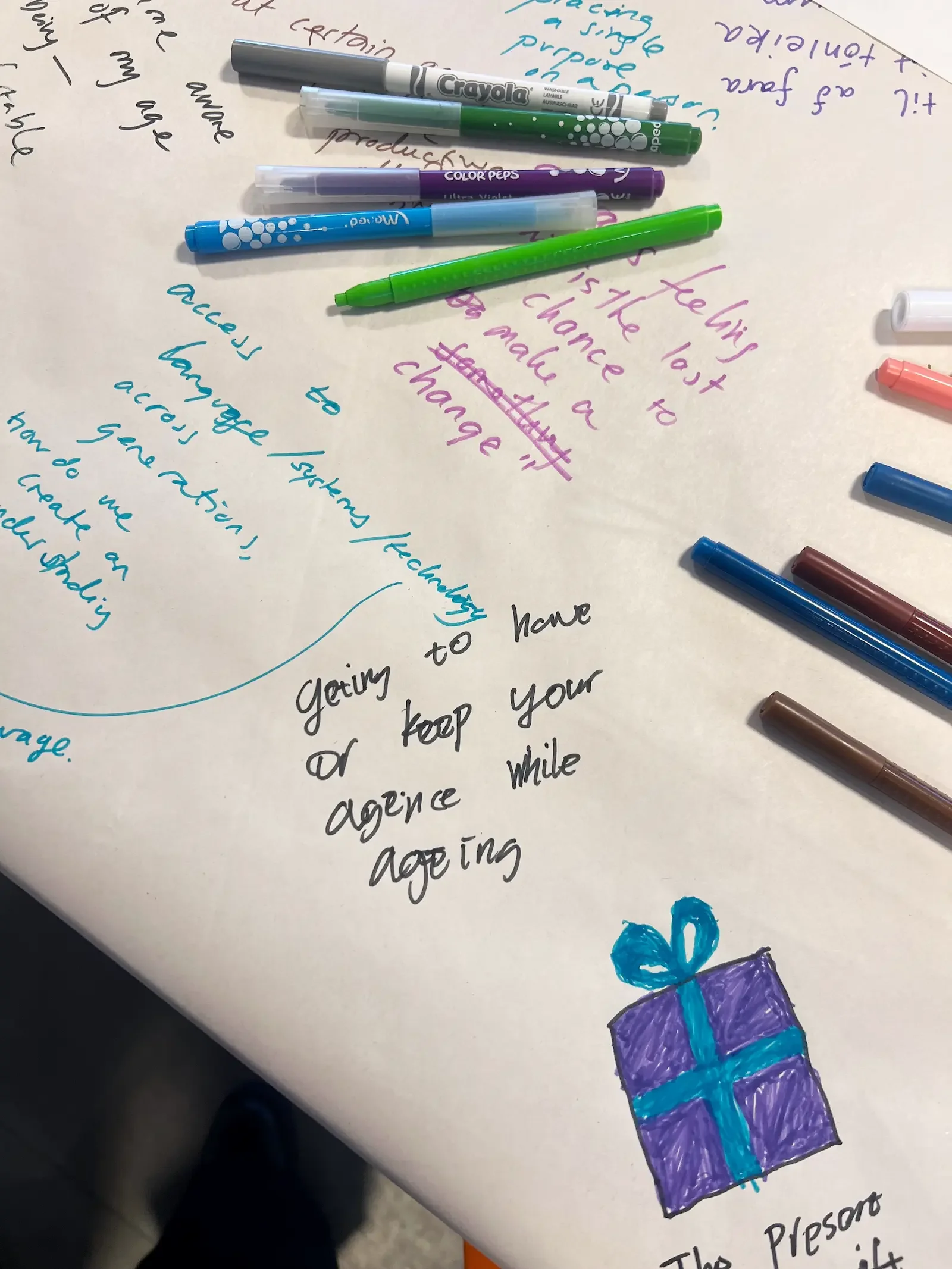
In the second workshop, the discussion deepened. The focus was no longer only on examples of ageism, but also on what lies behind them and what effects they have on self-image, social position and participation in society. The conversation addressed concepts such as roles, power, visibility, reduced opportunities and human worth.
This also made visible how ageism can become an internal voice. It can appear as a feeling that “this is the last chance” to change something, change career, start a family or take a new path. Participants reflected on how people often become more afraid of making mistakes, and less willing to allow themselves play and experimentation, as they grow older.
Shared future vision emerging
When the group reviewed the results together at the end of the second workshop it became clear that they envisioned a warmer, more inclusive and more human society. This vision was connected not only to the struggle against ageism, but also to broader ideas about the kind of society we want to build in the future.
Participants described a future in which diversity has more room, social ties are stronger, and society becomes more grounded, with a clearer awareness of its environment, its local surroundings and the value of being together. An inclusive society is created not only through changed attitudes, but through the way we design shared spaces, infrastructure and everyday life.
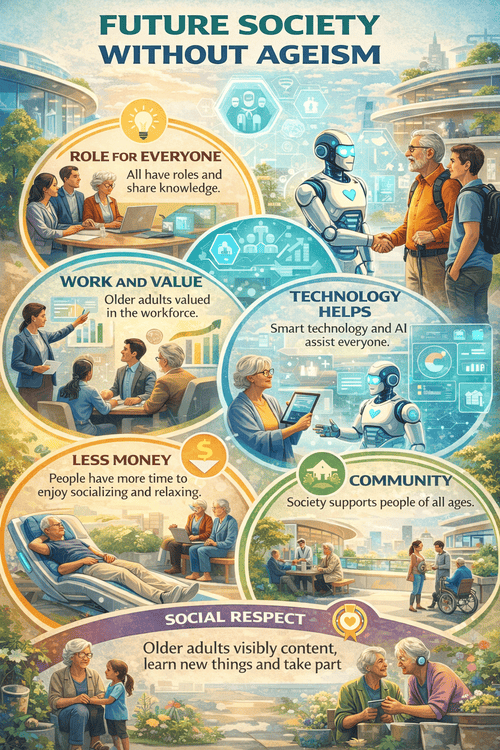
Participants mentioned open communities, hot tubs that encourage interaction, public transport, museums and community centres. These kinds of spaces and infrastructures can support participation, belonging and relationship-building across age groups.
A positive vision of the role of technology also emerged. Rather than seeing technology mainly as a force of separation, participants expressed the view that technology could create more room and time to be around others. Technology can be used with human connection, inclusion and quality of life as guiding principles. Technology can then be a tool that supports more common spaces and participation.
The outcome shows that conversations about ageism are not only about identifying a problem, but also about imagining a different future. A future in which people are not defined by their ID number, but by human dignity, connection, curiosity, diversity and the capacity to participate.
Key findings
• Ageism affects people of all ages, not only older age groups.
• Age is too often used as a measure of competence, worth, opportunity and social status.
• Ageism has both external and internal effects and can become part of how people understand themselves.
• Connection, interest, learning and participation do not depend on age and become stronger when generations meet.
• A future society without ageism will be warmer, more grounded, more inclusive and more relationship-centred.
• Open communities and accessible shared spaces, such as hot tubs, public transport, museums and community centres, matter for participation and belonging.
• Under the right conditions, technology can become a bridge that creates more room for time together and stronger social ties.

